Metallurgy as the investment focus
Advance representative-sample testwork to assess recovery, beneficiation and processing alternatives for titanium and rare earths.
Titanium dioxide (TiO₂) is the principal quantitative highlight of the independent NI 43-101 Technical Report, with a conceptual TiO₂ Exploration Target of 2.6–4.6 billion tonnes at 10.6–11.7% TiO₂. Separately, the report supports a total rare earth oxides (TREO) Exploration Target across four principal drill-supported targets.
Conceptual Exploration Targets only. Exploration is insufficient to define a Mineral Resource; further work may not delineate one. These are tonnes of mineralised material, not tonnes of titanium, contained oxides or saleable products.
Together, aiming for global leadership.
For PAT alone, the report presents an estimated potential of 1.7 to 2.8 billion tonnes of titanium-bearing mineralised material. We invite investors to build this path with the Expoente do Titânio do Alto Paranaíba Project — identified in technical documents as the Mata da Corda Project — and advance its metallurgical development, with the ambition of positioning it among the world's largest titanium projects.
TiO₂ is presented first as a principal quantitative attribute of the Expoente do Titânio system. The TiO₂ and TREO targets are separate sensitivity outcomes, must not be combined, and neither is a Mineral Resource or Mineral Reserve.
Separate conceptual TiO₂ Exploration Target for Patos, Olegário South, Pindaíbas and Lagoa Formosa combined.
Separate conceptual TREO Exploration Target for the same four drill-supported targets, with meaningful NdPr and MREO components identified in the analytical database.
TITANIUM EXPLORATION TARGET consolidated the project’s technical documentation and advanced its assessment through the independent NI 43-101 report prepared by Leonardo Deringer Fraga, P.Geo. (EGBC No. 61611), effective 30 August 2026.
The technical foundation combines drilling, sampling, laboratory assays, density measurements, geological records and prior studies. The 419-hole database incorporates the 2024–2025 exploration program, providing a technical archive to guide the next stages of exploration and project assessment.
Leonardo Deringer Fraga, P.Geo. (EGBC No. 61611), is the sole QP responsible for the 30 August 2026 report. His review combines direct prior involvement in the exploration program, technical database checks and a property inspection on 31 March and 1 April 2026. His relationship to the project and independence declaration are disclosed in the report and certificate.
NI 43-101 · Items 2–4 / Itens 2–4 · p. 8 · Supporting documentation available on request.
TITANIUM EXPLORATION TARGET maintains an extensive technical archive of exploration studies, drilling records, laboratory analyses and geological documentation. The company intends to integrate and submit this material to the QP to deepen the assessment of Expoente do Titânio’s potential.
The 844.66 km² portfolio, 419-hole database and additional targets outside current quantitative ranges underpin the company’s ambition to investigate a project of global significance. TITANIUM EXPLORATION TARGET intends to assess whether this potential could exceed international references such as Pitfield in Australia and position Expoente do Titânio among the world’s largest titanium deposits. This is the company’s ambition, not a ranking or conclusion established by the current technical report.
The project portfolio and the scope of the three RFPs are different. The area reconciliation supplied in Leonardo Fraga’s clarification identifies 51 titles totaling 844.6568 km². PAT, PIN and OLE’s three RFP titles total 47.8537 km², approximately 5.67% of that portfolio. Title area is not the same as a mineralised footprint.
| Scope | ANM | km² |
|---|---|---|
| PAT | 833.402/2023 | 12.8064 |
| PIN | 833.403/2023 | 19.8298 |
| OLE | 833.399/2023 | 15.2175 |
| Three RFP titles | — | 47.8537 |
| Remaining 48 titles | — | 796.8031 |
| 51-title portfolio | — | 844.6568 |
The public NI 43-101 Exploration Target ranges cover PAT, OLE, PIN and LAF at target scale. They must not be presented as quantities confined to those three RFP titles or extrapolated across the full portfolio. RFP terminology and local assessments do not automatically establish CIM/NI 43-101 Mineral Resource categories.
Sources: area reconciliation in the document “clarification”, signed in text by Leonardo Deringer Fraga; NI 43-101 Items 4 and 9. The clarification is a separate source and is not a revision of the signed NI 43-101 report.
The public NI 43-101 range for PAT alone is 1.7–2.8 billion tonnes of mineralised material at 10.4–11.4% TiO₂. This scale reinforces the project’s significance and guides metallurgical work integrated with PAE preparation.
The reported titanium and rare-earth ranges, the shallow regolith setting and the targets excluded from current quantities provide reasons to pursue systematic exploration. Further studies will determine how much of that potential can be converted into Mineral Resources and, if justified, later development studies. The current report does not rank Expoente do Titânio among global titanium deposits.
NI 43-101 · Item 9 / Item 9 · p. 20 · Supporting documentation available on request.
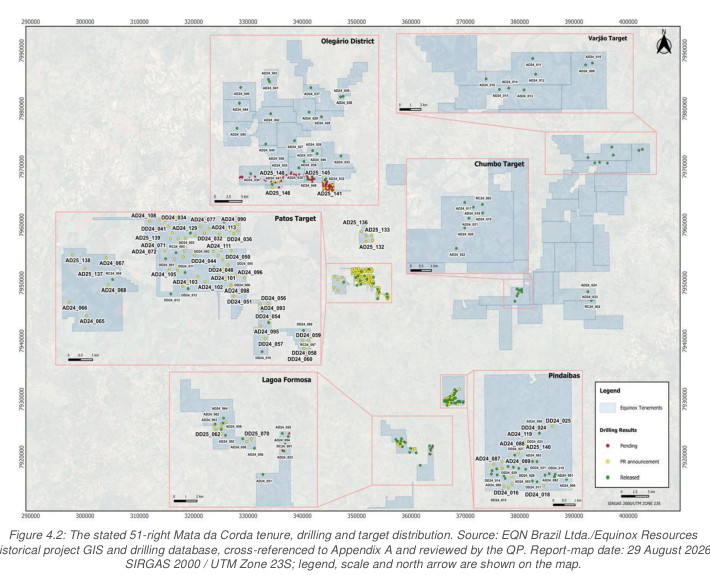
Expoente do Titânio is located in western Minas Gerais within the Alto Paranaíba region. The report states a total tenure area of 84,465.68 hectares (approximately 844.66 km²) across 51 ANM exploration rights. The project centre is approximately 15 km east-northeast of Patos de Minas in straight-line distance.
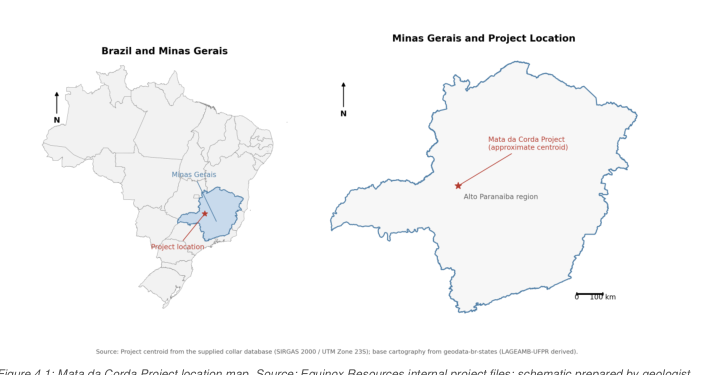
PAT: Patos · OLE: Olegário South · PIN: Pindaíbas · LAF: Lagoa Formosa. Polygons show mineral titles or target areas according to the original legend; they do not represent Mineral Reserves.
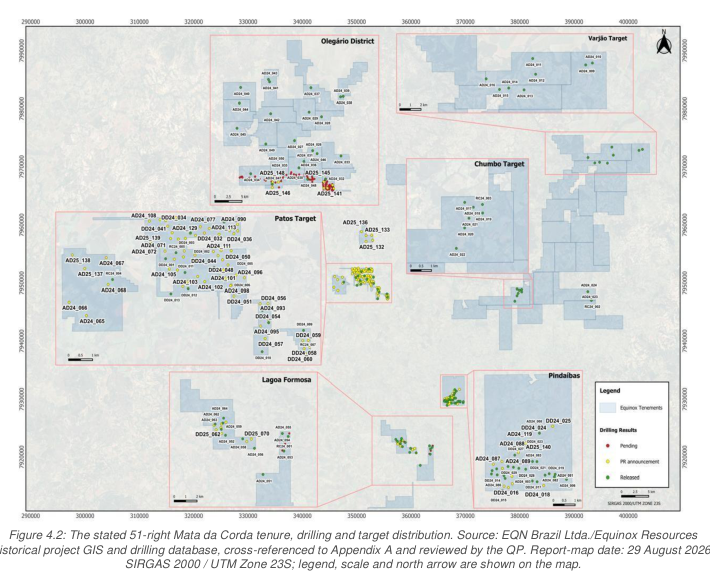
PAT: Patos · OLE: Olegário South · PIN: Pindaíbas · LAF: Lagoa Formosa. Polygons show mineral titles or target areas according to the original legend; they do not represent Mineral Reserves.
Largest scale target and dominant mass contributor in the current portfolio.
104 holes · 1,958.7 mMost heterogeneous and threshold-sensitive principal target.
149 holes · 1,850.8 mSmallest principal target but the tightest continuity benchmark in current drilling.
121 holes · 1,910.2 mBench-controlled geometry with a comparatively narrow tonnage range.
27 holes · 428.7 m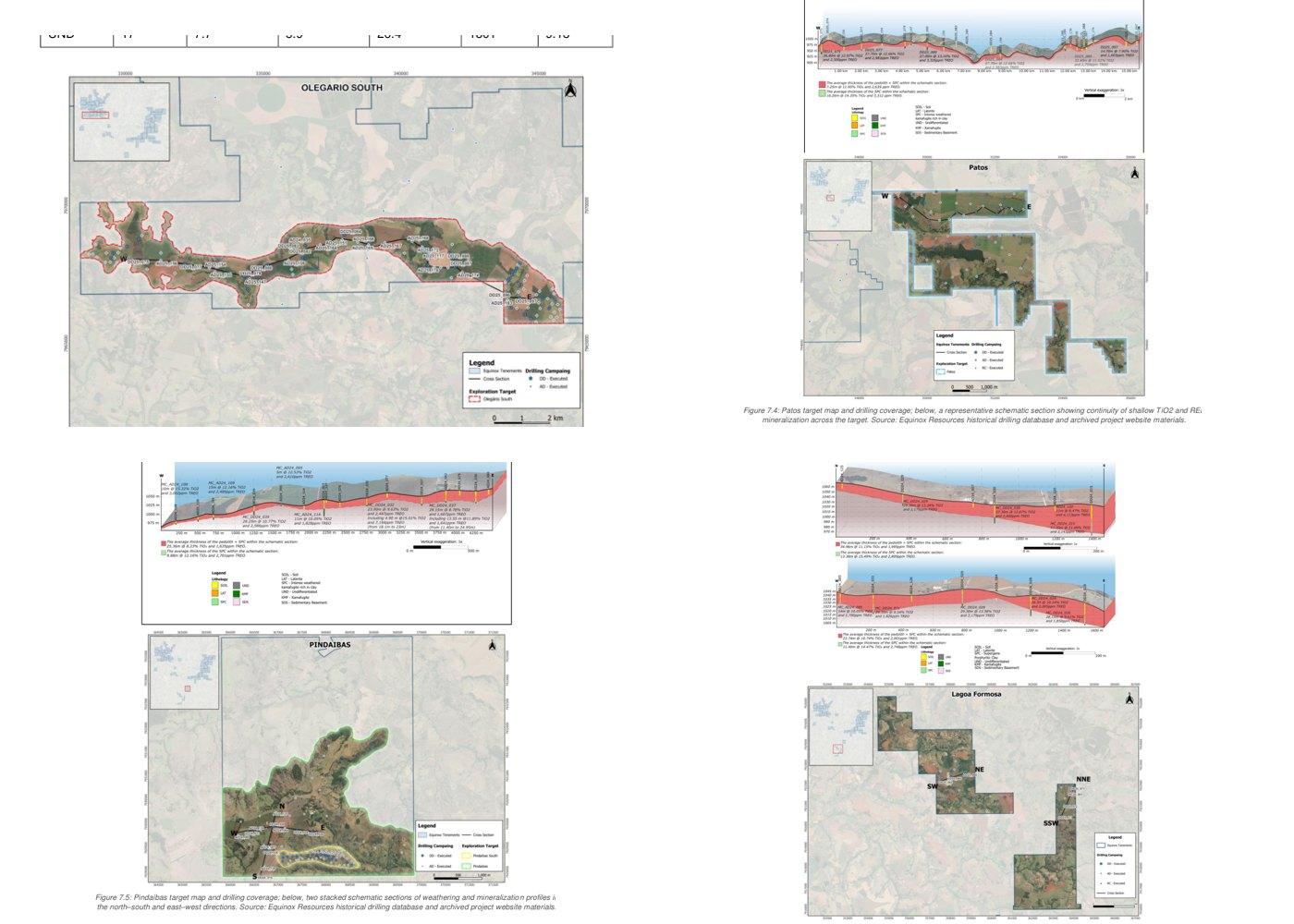
PAT: Patos · OLE: Olegário South · PIN: Pindaíbas · LAF: Lagoa Formosa. Polygons show mineral titles or target areas according to the original legend; they do not represent Mineral Reserves.
| TiO₂ | Quantity | Grade |
|---|---|---|
| Patos (PAT) | 1 700–2 800 Mt | 10.4–11.4% |
| Olegário South (OLE) | 400–1 000 Mt | 10.1–12.0% |
| Pindaíbas (PIN) | 200–320 Mt | 11.0–12.2% |
| Lagoa Formosa (LAF) | 360–420 Mt | 12.2–12.7% |
| Combined four targets | 2 600–4 600 Mt | 10.6–11.7% |
| TREO | Quantity | Grade |
|---|---|---|
| Patos (PAT) | 3 000–3 300 Mt | 2 200–2 300 ppm |
| Olegário South (OLE) | 740–1 500 Mt | 1 800–2 300 ppm |
| Pindaíbas (PIN) | 270–310 Mt | 2 100–2 300 ppm |
| Lagoa Formosa (LAF) | 410–430 Mt | 2 300–2 400 ppm |
| Combined four targets | 4 400–5 600 Mt | 2 100–2 300 ppm |
drillholes in the current exploration database
named drilled targets; 4 currently quantified
stated tenure across 51 ANM exploration rights
The visual material below is explanatory and conceptual. It illustrates the exploration framework described in the NI 43-101 Technical Report and does not depict Mineral Resources, Mineral Reserves or resource boundaries.
TiO₂: 2.6–4.6 Bt @ 10.6–11.7% TiO₂
TREO: 4.4–5.6 Bt @ 2,100–2,300 ppm TREO
Both are conceptual Exploration Targets for PAT, OLE, PIN and LAF only. They are separate sensitivity outcomes and must not be combined.
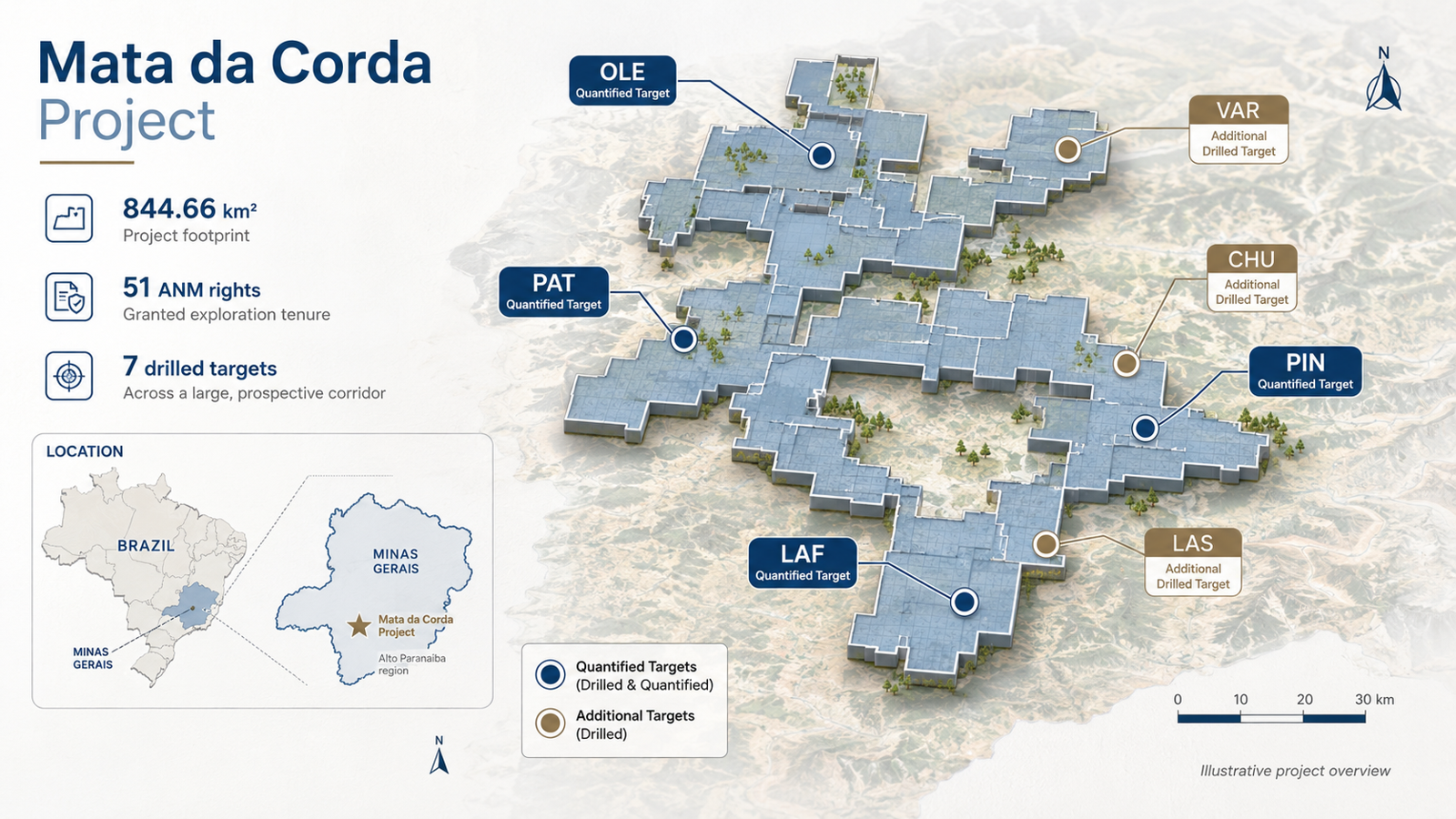
Illustrative view of project scale and the distinction between the four quantified targets and additional drilled targets.
PAT: Patos · OLE: Olegário South · PIN: Pindaíbas · LAF: Lagoa Formosa. Polygons show mineral titles or target areas according to the original legend; they do not represent Mineral Reserves.
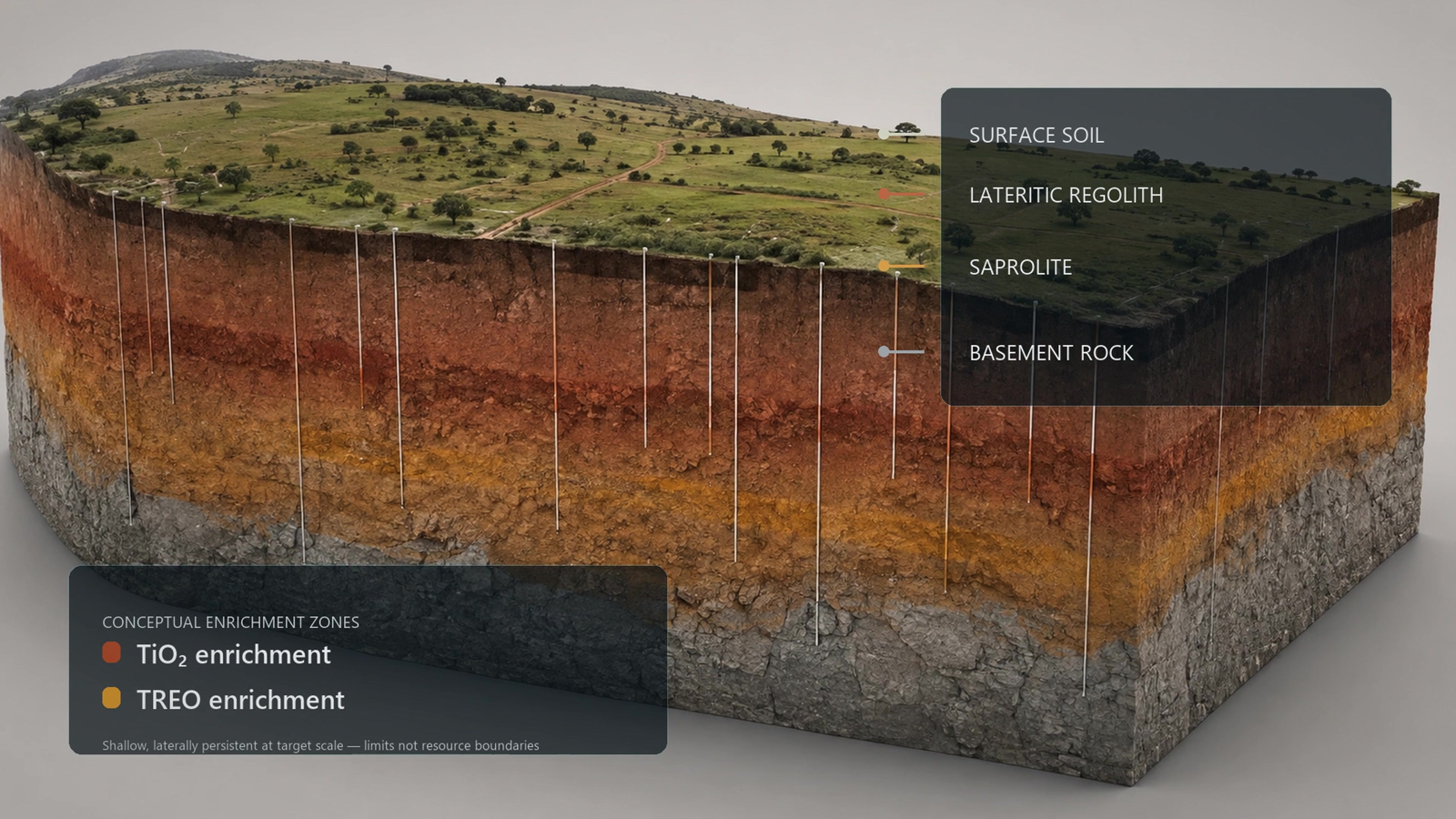
Conceptual section illustrating a shallow weathering profile and TiO₂–TREO enrichment zones. Not to scale and not a resource model.
Surface soil → lateritic regolith → saprolite → basement rock. TiO₂: titanium dioxide. TREO: total rare earth oxides. Conceptual model, not to scale.
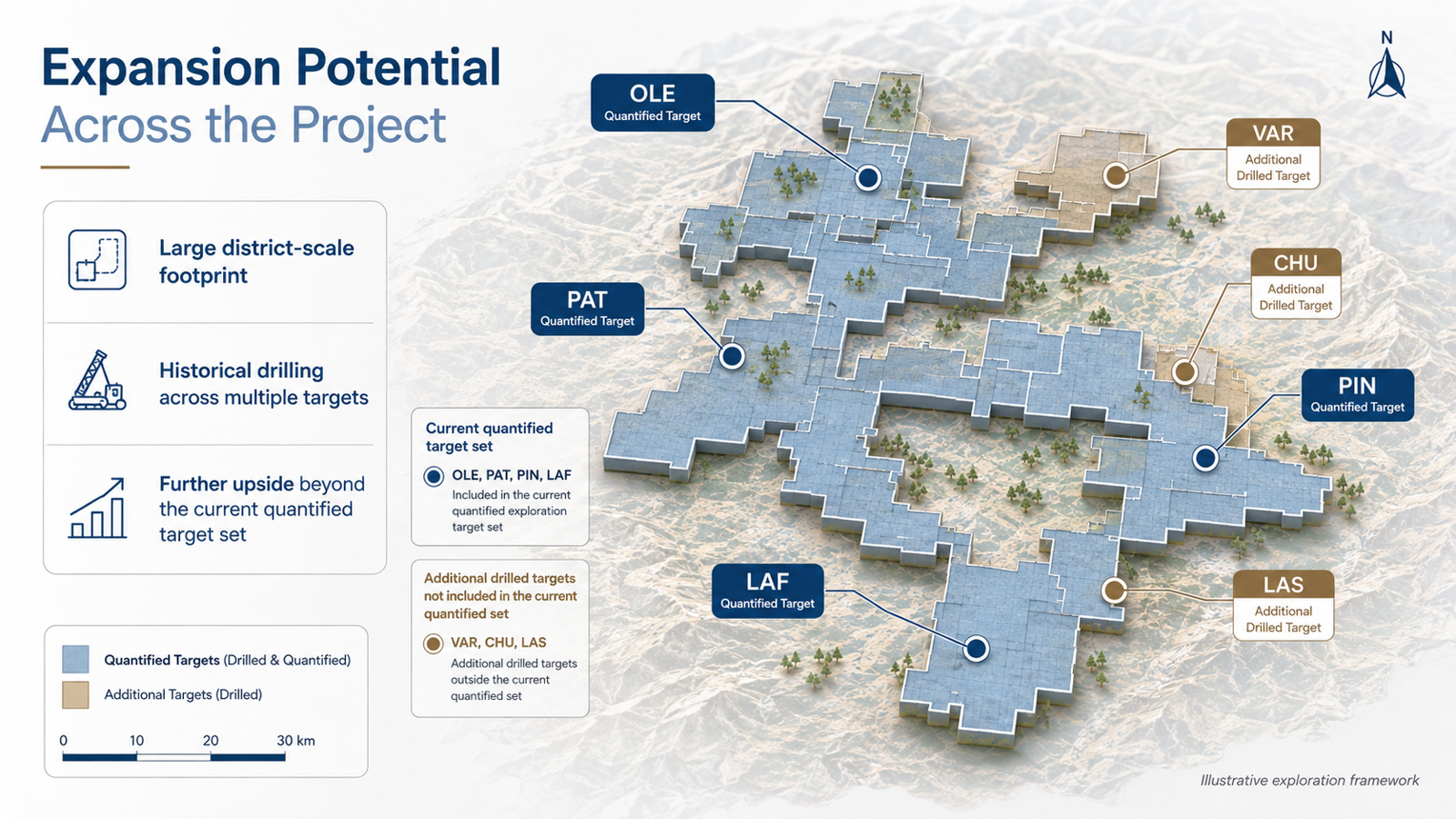
Illustrative framework for CHU, LAS, VAR, incompletely tested extensions and other prospective ground excluded from current quantities.
CHU, LAS and VAR: additional targets excluded from current quantities. Expansion areas are conceptual; no additional tonnage is assigned.
TiO₂ and TREO are the quantitative reporting variables. The analytical database also identifies meaningful NdPr and MREO components. Niobium, scandium and zirconium are recorded in the multi-element assay suite and represent future technical-research opportunities; no economic significance, recovery or product potential is established for them at this stage.
Separate conceptual target.
Total rare earth oxides with meaningful NdPr and MREO components.
Recorded analytes; no quantitative or economic significance established at this stage.
3,685 assay intervals · 359 density determinations
Rare earths form a separate exploration workstream at Expoente do Titânio. For PAT, OLE, PIN and LAF combined, the NI 43-101 report presents a conceptual Exploration Target of 4.4–5.6 billion tonnes of mineralised material at 2,100–2,300 ppm total rare earth oxides (TREO), equivalent to 0.21–0.23% TREO.
The analytical database identifies neodymium and praseodymium (NdPr) and magnet rare earth oxide components (MREO). Their distribution, mineral hosts, recovery and potential product quality will be assessed through representative mineralogical and metallurgical testing. The titanium and TREO quantities may overlap and must not be added together.
drillholes · 6,359.3 m
auger / reverse circulation / diamond holes
assay intervals
density measurements from 126 diamond holes
The QP reviewed the collar and geology database, analytical and density records, blank/CRM/duplicate workbooks, geological photographs, selected certificates and calculations, and 14 candidate auger–diamond twin or near-twin pairs. Appendix C provides the 419-hole collar and survey schedule; the report also reproduces selected assay intervals in Appendix B.
This work supports the report’s conceptual exploration use. Material limitations remain, including gaps in independent check assays, the TiO₂ grade range of reference materials, auger recovery and bias checks, and additional dry-basis density verification. These limitations and their implications are described in Item 12.
NI 43-101 · Item 12 & Appendix C / Item 12 e Apêndice C · p. 34 · Supporting documentation available on request.

Titanium and rare earths connect Alto Paranaíba with global advanced-material supply chains. Participation in the project centres on advancing metallurgy, integrated with PAE preparation, to turn technical knowledge into development decisions.
Speak with the investment teamThree years of studies underpin the project’s progression toward its next stage: preparation of the Economic Exploitation Plan (PAE). According to the company’s update, three Final Exploration Reports (RFPs) have been submitted and Leonardo Fraga is preparing the next filings under a programme covering all 51 mining-right proceedings. The archive of 419 drill holes, laboratory analyses and technical studies provides the accumulated foundation for this progression. Metallurgical work supports recovery, product quality, flowsheet development and PAE engineering.
We seek investors to turn this mineral scale into a path toward industrial development. Together, aiming for global leadership in titanium.
Advance representative-sample testwork to assess recovery, beneficiation and processing alternatives for titanium and rare earths.
Integrate mineralogical and metallurgical results to guide the flowsheet, characterise products and support commercial positioning.
The progress dashboard will be updated as RFP filings advance and new technical results and PAE preparation milestones become available.
The drilling database brings together geological, assay, downhole survey and density records. This dataset supports representative sample selection, model integration and metallurgical planning associated with the PAE.
Record counts from the June 2025 drilling database retained in the technical archive. Documentation available to the review team.
Expoente do Titânio is the project’s commercial name. Original technical documents identify the project as Mata da Corda; original source maps retain that historical name.
Technical reference: independent NI 43-101 report effective 30 August 2026, prepared by Leonardo Deringer Fraga, P.Geo., EGBC No. 61611. Supporting reports, QP certificate and consent are retained in their original form and can be requested from the project team.
Request technical documentationTITANIUM EXPLORATION TARGET announces the completion of an independent NI 43-101 Technical Report for the Expoente do Titânio TiO₂ - REE Project in Minas Gerais, Brazil.
For the four principal drill-supported targets — Patos (PAT), Olegário South (OLE), Pindaíbas (PIN) and Lagoa Formosa (LAF) — the report supports a conceptual TiO₂ Exploration Target of 2,600–4,600 Mt at 10.6–11.7% TiO₂. Separately, it supports a conceptual TREO Exploration Target of 4,400–5,600 Mt at 2,100–2,300 ppm TREO (0.21–0.23%).
Corporate, investor and media contact
+55 31 99302-0969
+55 31 99707-4244
cida.andrade@titaniumglobalspe.com
Director
+55 31 99981-9233
ronaldo.amaral@titaniumglobalspe.com